![cascade-lockup-dark.png]](https://knowledgebase.cascadedebt.com/hs-fs/hubfs/Logos%20(new)/cascade-lockup-dark.png?height=40&name=cascade-lockup-dark.png)
Where to find them
Click the pen icon in the left-hand rail to open Manage, then expand Audit.
Payment Audit
A payment audit flags payments that warrant evidence — unusual amounts, unusual timing, patterns that do not fit the loan's history — and asks the borrower to produce supporting documentation for each.
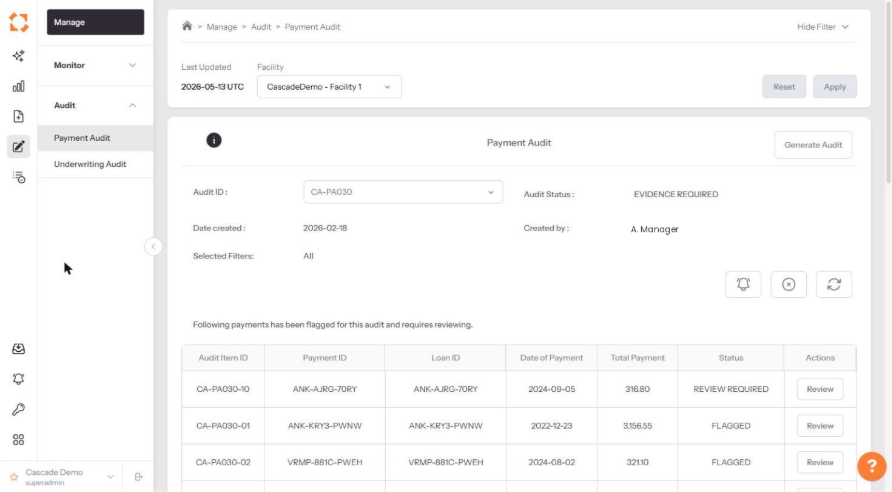
The audit header
|
Field |
Meaning |
|
Audit ID |
The audit's reference. Use the dropdown to move between audits on this facility. |
|
Audit Status |
Where the audit has got to overall — for example Evidence Required. |
|
Date created |
When the audit was generated. |
|
Created by |
Who generated it. |
|
Selected Filters |
The sampling criteria the audit was built with. |
The audit items
Each row is a flagged payment, showing its audit item ID, payment ID, loan ID, date of payment, total payment and status. Click Review to open the item, see the evidence provided and accept or reject it.
|
Item status |
Meaning |
|
FLAGGED |
The algorithm has selected this payment. Evidence has not yet been supplied. |
|
REVIEW REQUIRED |
Evidence has been supplied and is waiting on the investor's assessment. |
Generating an audit
Click Generate Audit at the top right. Audits can be created at any frequency and sample size. The three icons beneath the header send a reminder, cancel the audit, and refresh its status.
Underwriting Audit
An underwriting audit tests disbursements rather than receipts. The same oversampling logic applies, but the evidence requested is the origination file — the documents that should have been obtained before the loan was written.
Investor and borrower agree in advance what documentation each disbursement requires. The borrower uploads the evidence; the investor reviews it and judges whether it is sufficient.
How an audit runs
- Generate. Set the frequency and sample size. Cascade selects the items, oversampling the suspicious.
- Notify. The borrower is alerted that evidence is required.
- Evidence. The borrower uploads supporting documents against each flagged item.
- Review. The investor opens each item and accepts or rejects the evidence.
- Report. A final audit report is produced for internal compliance records.
Why oversampling matters
A random sample of 100 payments from a 50,000-payment book will, by construction, be mostly unremarkable — and will tell you almost nothing about the payments that are not. Oversampling inverts that: the sample is weighted toward the items whose characteristics differ from the portfolio norm, so a clean result is meaningful evidence rather than a statistical near-certainty.
It also changes how you read a result. A rejected item in an oversampled audit is not necessarily a scandal — the algorithm deliberately went looking for edge cases. What matters is the rate and the pattern across audits over time.