![cascade-lockup-dark.png]](https://knowledgebase.cascadedebt.com/hs-fs/hubfs/Logos%20(new)/cascade-lockup-dark.png?height=40&name=cascade-lockup-dark.png)
Where to find it
Open Data from the left-hand rail, click Insights, then DPD Calculation.
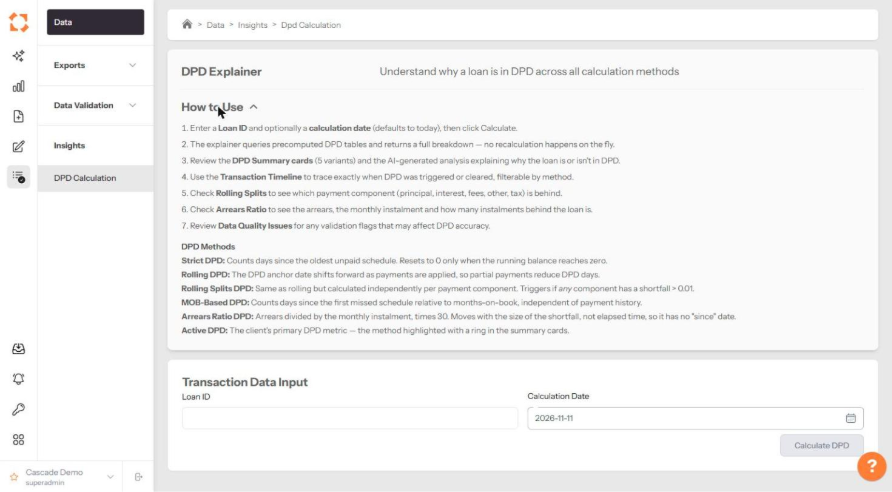
The methods
|
Method |
How it counts |
|
Strict DPD |
Days since the oldest unpaid schedule. Resets to 0 only when the running balance reaches zero. |
|
Rolling DPD |
The anchor date shifts forward as payments are applied, so partial payments reduce DPD days. |
|
Rolling Splits DPD |
As rolling, but calculated independently per payment component. Triggers if any component has a shortfall above 0.01. |
|
MOB-Based DPD |
Days since the first missed schedule relative to months-on-book, independent of payment history. |
|
Arrears Ratio DPD |
Arrears divided by the monthly instalment, times 30. Moves with the size of the shortfall rather than elapsed time, so it has no "since" date. |
|
Active DPD |
The client's primary DPD metric — the method highlighted with a ring in the summary cards. |
The distinction that trips people up most often is strict versus rolling. Under strict, a partial payment does not move the clock — the oldest unpaid schedule is still unpaid. Under rolling, it does. A borrower making consistent partial payments will look far healthier on rolling than on strict, and both numbers are correct.
Running an explanation
- Enter a Loan ID. This must be a loan identifier, not a transaction or payment ID.
- Optionally set a Calculation Date. It defaults to today.
- Click Calculate DPD.
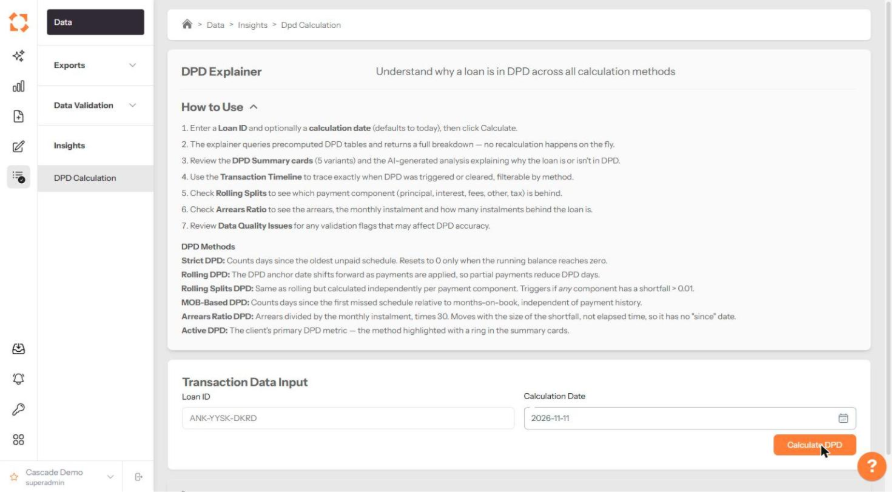
The explainer queries precomputed DPD tables. Nothing is recalculated on the fly, so what you see is exactly what the rest of the platform is using.
Reading the output
- DPD Summary cards — five variants, one per method, with an AI-generated analysis explaining why the loan is or is not in DPD. The active method is ringed.
- Transaction Timeline — traces exactly when DPD was triggered or cleared. Filterable by method, so you can see where two methods diverge.
- Rolling Splits — shows which payment component is behind: principal, interest, fees, other or tax.
- Arrears Ratio — the arrears, the monthly instalment, and how many instalments behind the loan is.
- Data Quality Issues — any validation flags on this loan that could affect DPD accuracy. Check this before concluding a DPD figure is wrong; a quarantined transaction upstream will produce a misleading number downstream.
- A client disputes your delinquency or PAR figure.
- A loan has appeared in a covenant breach and you need to explain why.
- Two reports disagree about the same loan.
- You are agreeing a DPD methodology during structuring and want to see what each option does to a real loan.
When to reach for it
- A client disputes your delinquency or PAR figure.
- A loan has appeared in a covenant breach and you need to explain why.
- Two reports disagree about the same loan.
- You are agreeing a DPD methodology during structuring and want to see what each option does to a real loan.